
Public notices about unregistered operators
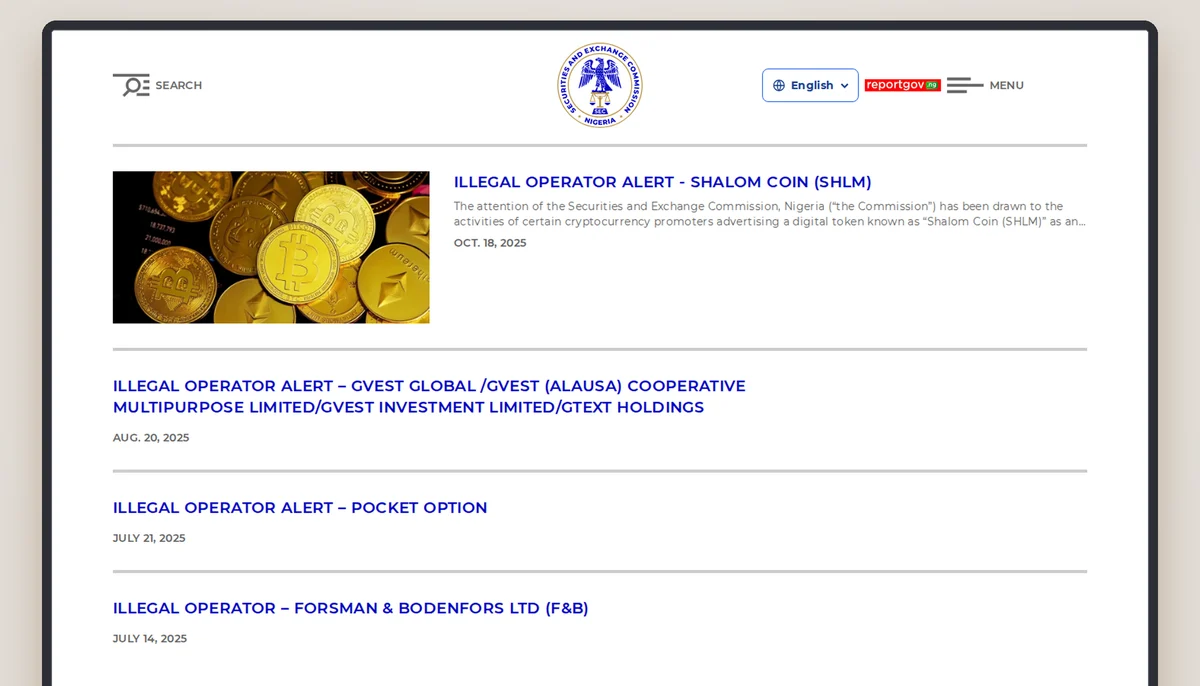
The Securities and Exchange Commission of Nigeria publishes public notices about operators it says are not registered. The table above shows those notices as the Commission published them. Each row records what the source published, not a finding of this site. This page explains what each column shows and how to read a notice.
SEC notices on unregistered operators
The operator's name as the SEC wrote it and the notice's date where given.
| Name as the SEC wrote it | Published | Kind of notice | Source |
|---|---|---|---|
| October 2025 | |||
| Shalom Coin (SHLM) | 18.10.2025 | Illegal operator alert | SEC ↗ |
| August 2025 | |||
| GVEST GLOBAL | 20.08.2025 | Illegal operator alert | SEC ↗ |
| July 2025 | |||
| Forsman & Bodenfors LTD (F&B) | 14.07.2025 | Illegal operator alert | SEC ↗ |
| Pocket Option | 21.07.2025 | Illegal operator alert | SEC ↗ |
| June 2025 | |||
| CBEX (Crypto Bridge Exchange) | 11.06.2025 | Illegal operator alert | SEC ↗ |
| CMTrading | 20.06.2025 | Illegal operator alert | SEC ↗ |
| Punisher Coin | 05.06.2025 | Illegal operator alert | SEC ↗ |
| Sapphire Scents Limited | 19.06.2025 | Illegal operator alert | SEC ↗ |
| Value Growth Platform | 30.06.2025 | Illegal operator alert | SEC ↗ |
| ZugaCoin and Samzuga GPT | 17.06.2025 | Illegal operator alert | SEC ↗ |
| May 2025 | |||
| Silverkuun Investment Cooperative Society | 28.05.2025 | Illegal operator alert | SEC ↗ |
| March 2025 | |||
| My Shares And UYJ Multitrade Limited | 06.03.2025 | Illegal operator alert | SEC ↗ |
| Provest | 06.03.2025 | Illegal operator alert | SEC ↗ |
| November 2024 | |||
| Marino FX Ltd | 25.11.2024 | Illegal operator alert | SEC ↗ |
What the notices are
A public notice is a statement by the Commission. It may be a warning, an alert, or an update. Notices vary in how much they say. Some name an operator and say that the operator is not registered. Others give more detail about what the operator is doing. The table above shows the notices as the Commission published them.
The notices are not court judgments. They are the Commission's published position. They are evidence that the Commission considers the named operator unregistered. They do not prove that the operator is unlawful. A notice is a public statement, and its weight depends on what it says.
What each column shows
The table has columns for the name, the date the source published it, the kind of notice, and a link to the original. The name is exactly as the source wrote it. The date is the date the Commission published the notice. The kind of notice may be 'warning', 'alert', 'update' or something else. The link goes to the Commission's own page.
A row records what the source published. It is not a finding of this site. This site does not add or remove names, does not change dates, and does not interpret the kind of notice. The table is a copy of the public record.
Why dates may be missing
Where a date is missing at the source, the site says so and does not substitute its own. A missing date is a gap in the source. It is shown as 'Not given'. The Commission may not date every notice. The absence of a date does not mean the notice is invalid; it means the source did not provide one.
The date is important because it tells you when the Commission published the notice. A notice from years ago may still be relevant, but the operator may have changed its name or stopped operating. The date helps you judge how current the notice is.
What a notice does and does not say
A notice may say that an operator is not registered with the Commission. That is a statement of fact about the register. It may also say that the operator is offering services to the public without registration. That is the Commission's conclusion. The notice may not say that the operator is a fraud or a scam. The Commission does not use those words in every notice.
A notice is not a finding of this site. It is the Commission's published statement. The reader should read the notice itself to see what it says. The table above links to the original.
How to use the notices
If you are considering a platform, check the notices table. Search for the platform's name. If there is a notice, read it. The notice may give details about what the Commission says the platform is doing. That information is useful, but it is still the Commission's statement.
The notices table is not a complete list of all unregistered operators. The Commission may not have issued a notice about every operator that is not registered. A name not on the notices table does not mean the operator is registered. Check the register as well.
What to do if a platform is named in a notice
If a platform you are considering is named in a notice, read the notice carefully. See what the Commission says. Then check the register. The notice may say the operator is not registered. Then ask the platform for its legal entity and home regulator. The platform may have an explanation.
The decision is yours. This site does not tell you what to do. It shows the notices and explains what they mean. A notice is a warning sign, but it is not a verdict. The reader must weigh the evidence and decide.
A notice is not the same as a finding of fraud
The Commission publishes a notice when its records do not show an operator holding a registration. That is a statement about the register, not a judgement about the operator's honesty. A platform can be unregistered for many reasons, including that it has never applied or that its application is still being processed. Readers should not read a notice as proof that the operator has stolen money or broken a criminal law.
The wording of each notice is careful. It typically says the operator is 'not registered' or 'not licensed' by the Commission. It does not say the operator is a scam, a fraud, or a Ponzi scheme. The Commission leaves that determination to law enforcement and the courts. Treating a notice as an accusation can lead to wrong conclusions about the people behind a platform.
This matters because online discussions often blur the line. A person may post a notice and call the operator a scam in the same sentence. The site does not do that. A notice is one fact among many. A reader who wants to judge a platform's character should look at court records, payment disputes, and the operator's own conduct, not only at a register entry.
Some notices name a platform more than once
The notices are not a single list that is updated in place. The Commission publishes a new notice when it becomes aware of a new unregistered operator. That means the same platform can appear in several notices over time. Each notice has its own date and its own wording. A reader who searches the notices may see the same name attached to different dates.
Multiple notices do not necessarily mean the Commission has taken stronger action. They often mean the operator has continued to operate or that the Commission has received new complaints. The Commission may reissue a notice to warn the public again, especially if the platform changes its web address or trading name. The notices are warnings, not a running tally of offences.
When reading the table on this page, a name that appears more than once should be read alongside the notice dates. The site's table shows what the Commission published and when. It does not merge duplicate entries. A reader who wants the full history of one platform may need to view each notice separately. The table is a finding aid, not a summary.
A notice can name a website, a phone number, or an address
The Commission does not always publish a single company name. Sometimes the notice identifies an operator by the website where it does business. Sometimes it lists a phone number or a physical address. A platform may use several trading names, but the notice may mention only one of them. That can make it hard to match a notice to the platform a reader has in mind.
The table on this page reproduces what the Commission published. If the Commission did not publish a column for a piece of information, the table leaves the cell blank. A blank cell is not an error on the site's part. It means the notice itself did not contain that detail. Readers should not assume a platform is not in a notice because the name does not appear; the website address may be the identifier.
To use the notices well, a reader should search by more than one identifier. A trading name, a web domain, and a phone number may all lead to the same entry. The Commission's own search tool may not support every field. The site's table shows the fields the Commission included. Where a notice is short, the table is short. The reader's task is to match the platform's own pages against what the notice shows.
The absence of a notice is not evidence of registration
The Commission does not publish a notice for every unregistered operator it knows about. The notices are a selection. The Commission prioritises operators that have drawn many complaints or that are widely advertised. An operator may be unregistered and yet never appear in a notice. The absence of a notice does not mean the operator is registered.
The register of registered operators is the only place where a reader can see whether the Commission has granted a registration. The notices are a supplement, not a replacement. A reader who checks only the notices may wrongly conclude that a platform is registered because it is not named. The correct order is to check the register first, then the notices.
The site's table shows the notices the Commission has published. It is not a complete list of every unregistered operator in Nigeria. No such list exists. The Commission itself warns that new unregistered operators appear regularly. A reader who relies on the notices as a full list will miss many platforms that are not registered. The notices are a warning system, not a census.
The Commission may act against an operator without a notice
A notice is only one form of action. The Commission can also issue cease-and-desist orders, refer a matter to the police, or block a website through other authorities. Those actions may not be published as a notice. A platform could be under investigation or subject to an order and yet not appear in the notices table. The notices are not a log of every enforcement step.
The Commission's enforcement powers come from the Investment and Securities Act. The Act allows the Commission to take administrative measures against unregistered operators. Some of those measures are confidential. The Commission may not announce them until a later stage. A reader who sees no notice should not assume the Commission has done nothing.
For a reader checking a specific platform, the notices are one source among several. The Commission's website may publish other documents, such as circulars or warnings, that are not in the notices table. A thorough check would include those documents. The site's table is limited to what the Commission calls public notices about unregistered operators. Other actions are outside the table's scope.
A notice from an older year may no longer be current
The Commission does not withdraw or delete notices when an operator later becomes registered. The notice remains online as a historical record. That means a platform may have been unregistered at the time of the notice but registered later. The notice is not automatically updated. A reader who sees an old notice may wrongly think the platform is still unregistered.
The register of registered operators is the source for current status. If a platform appears on the register, the register entry is the more recent fact. The notice is still true as of its publication date, but it may no longer describe the platform's status. The site's table shows the notice date for this reason. A reader should compare the notice date with the register entry date.
There is no simple rule for how long a notice remains relevant. The Commission may issue a new notice that supersedes an older one, but it may not say so. The reader's job is to check the register and the notices together. If the register shows a current registration, the older notice should be read as history. If the register shows no registration, the notice remains a warning.
Key facts
Read next
Licence questions people send us
What is the difference between a notice and a court judgment?
A notice is a public statement by the Commission. It is the Commission's position. A court judgment is a decision by a court after hearing evidence. A notice is not a finding of fact. It is the Commission's published statement. The reader should treat it as such.
How often are the notices updated?
The notices table is read from the Commission's published circulars and notices once a week. The Commission may publish new notices at any time. The table above reflects the latest read. A notice that appears today may not have been there last week.
What if a notice has no date?
If a date is missing at the source, the site shows 'Not given'. The Commission may not date every notice. A missing date is a gap in the source. It does not mean the notice is invalid. The reader can still read the notice and follow the link to the original.
Does a notice mean the platform is a scam?
No. A notice means the Commission has published a statement about the operator. The notice may say the operator is not registered. It may not use the word 'scam'. The Commission's notices vary in how much they say. Read the notice itself to see what it says.
What if a platform is not on the notices table?
A name not on the notices table means the Commission has not published a notice about that operator. It does not mean the operator is registered. Check the register as well. The notices table is not a complete list of all unregistered operators.
Open an account with FxPro
FxPro is an international broker offering CFDs on currencies, metals, indices, shares and crypto. CFDs are leveraged and carry a high risk of losing the money deposited. This site is not the broker and takes no money from you.