
How to search the SEC Nigeria register
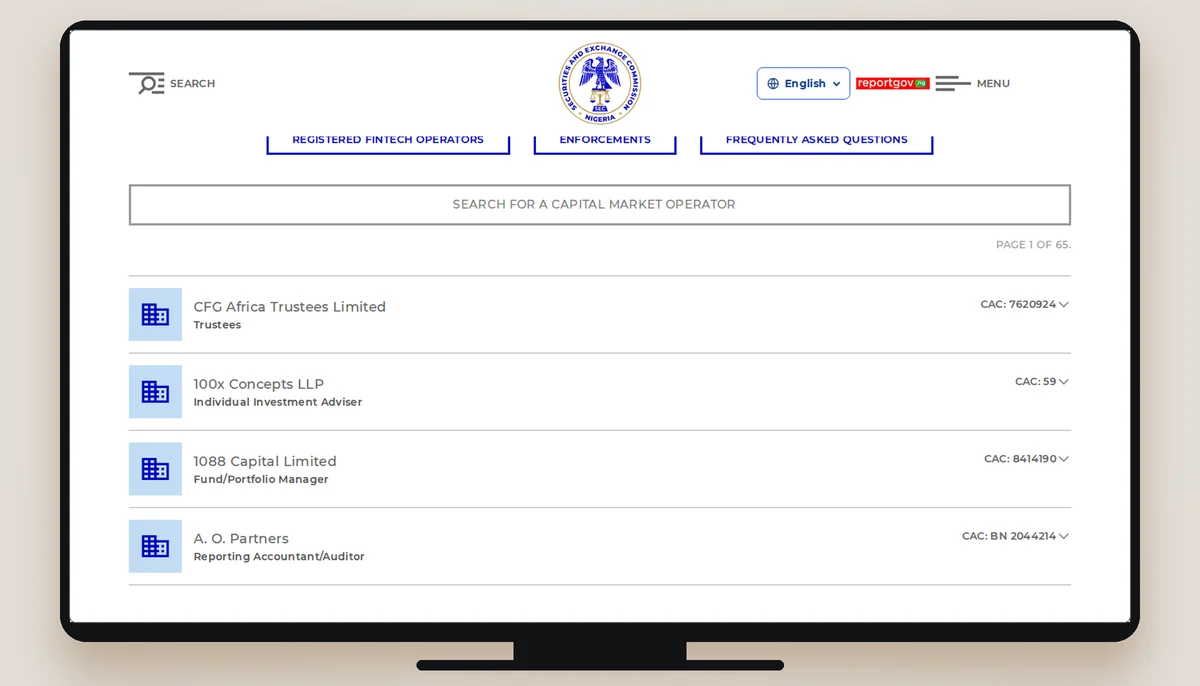
The Securities and Exchange Commission of Nigeria publishes a register of operators it has approved. This page explains how to search that register, what to read in a result, and what to do if a name is not found. The steps are simple, but the order matters. A search can fail on spelling, and a nil result needs a second check before you conclude anything.
Start with the exact company name
The register search works on the name the Commission has on file. That name is usually the legal entity name, not the trading name or the brand you see advertised. A platform may trade under a short name while its registered entity has a longer name. The search will not find the short name if the Commission has registered the long one.
Before you search, ask the platform for its legal entity name. The platform's own pages often state it in the terms, the privacy policy or the client agreement. If they do not, ask customer support. Use that exact name in the register search. Do not add words like 'Ltd' unless the source shows them. The search is not fuzzy; a small spelling difference can return no result.
Read the category and the status
A result on the register shows more than a name. It shows a category, such as broker, dealer or issuing house. The category tells you what the Commission has registered that entity to do. A registration in one category does not cover other activities. An entity registered as a broker is not thereby registered to deal in digital assets.
The register may also show a status. That status is part of the record. It may say 'active', 'inactive' or something else. Read it. Do not assume that a name on the register means the entity is currently allowed to do everything it advertises. The category and status together tell you what the Commission has actually registered.
Compare name and address with the platform's pages
The register may show an address for the registered entity. Compare that address with the address the platform gives on its own pages. A mismatch is not proof of wrongdoing, but it is a reason to ask the platform to explain. The platform may have moved, or it may be using a different entity for your country.
The name on the register should match the legal entity name the platform gave you. If the platform gave you a different name, search for that name as well. The register may contain several entities with similar names. The address and the category help you tell them apart.
If no result, search again
A nil result does not mean the platform is unlawful. It means the name you searched is not on the register. That could be because the platform is not registered with the SEC Nigeria, or because you searched the wrong name. Before you conclude anything, search again.
Check the spelling. Try the legal entity name from the platform's terms. Try the name without abbreviations. Try the parent company name if the platform is a subsidiary. The register is updated regularly, but it may not be instant. A platform that applied recently may not yet appear. A nil result is a signal to ask more questions, not a verdict.
Check the public notices
The SEC Nigeria also publishes public notices about operators it says are not registered. If a name is not on the register, check the notices table on this site. A notice is a public statement by the Commission. It may name an operator and say that the operator is not registered.
A notice is not the same as a court judgment. It is the Commission's published position. If there is a notice, read it. It may give details about what the Commission says the operator is doing. That information is useful, but it is still the Commission's statement, not a finding of fact by this site.
Call the SEC if a result is unclear
If you find a name on the register but the category or status is unclear, or if you cannot tell whether the entity is the one you are dealing with, call the Securities and Exchange Commission of Nigeria. The Commission has a public contact line. Ask for the registration status of the specific entity.
Do not rely on a third-party summary. The register on this site is a copy of what the Commission published. If the source is unclear, the Commission is the authority. A phone call can resolve a doubt that a web page cannot. The Commission's staff can tell you what a category means and whether an entity is currently registered.
Search the register before you fund an account, not after
The order of operations matters. A platform that asks for a deposit before you check the register has already moved you past the point where a search is most useful. Run the lookup on the SEC Nigeria website while you are still comparing platforms, not when a withdrawal has failed. The register is a snapshot of what the Commission has recorded, and the time to read that snapshot is before money leaves your bank account.
Once funds are with an operator, the register does not act as a refund mechanism. It cannot reverse a transfer or force a platform to return deposits. What it can do is give you a basis for asking questions before you commit. If a name is absent, that is a fact you can act on immediately; if it is present, that is also a fact to weigh against other checks.
Treat the search as a necessary step, not a final one. A platform that is not on the register may still be lawful under other regimes or may be operating illegally; the register alone does not settle that. But skipping the search because it is inconvenient hands the initiative to whoever is asking for your funds. The register is free to use and does not require an account.
A misspelt name is the most common reason for a false negative
The search box matches what you type against what the SEC has entered. A platform may advertise itself with a shortened name, a trading style, or a different spacing, while the register holds the full legal name. Searching for the marketing name can return no result even when the operator is registered. The lookup is not designed to guess what you meant.
Start with the exact name as it appears on the platform's own terms and conditions or account-opening documents. That is usually the legal entity name. If that returns nothing, try removing punctuation, abbreviations, or suffixes like 'Ltd' or 'Limited'. Then try a distinctive word from the name rather than the whole string. The register does not support wildcard characters, so shorter fragments often work better than long phrases.
A false negative can also come from a name change. Operators sometimes register under one name and later rebrand. The SEC register may still show the old name until the Commission updates it. If you find a similar name in the same category, open that record and compare the address and other details. The platform's own website may mention a former name in its history or legal pages.
The category on the register is not a licence to offer everything
A registered operator appears under a category that reflects what the SEC has permitted it to do. That category could be capital market operator, fund manager, issuing house, or another function. A platform registered as a fund manager is not automatically permitted to operate a digital asset exchange, and a platform registered for one activity cannot use that registration to cover a different line of business.
The category is the Commission's own classification, and it is printed in the register for a reason. Readers sometimes assume that any listing means a platform can trade forex or crypto. That is not what the register says. A name on the register means the SEC has a record of that operator in a specific capacity, not that every service the platform advertises falls within that capacity.
Before relying on a registration, read the category and compare it with what the platform is offering you. If there is a mismatch, the registration does not cover the service. The platform may have other authorisations, but those would come from other regulators. The SEC register only speaks to the SEC's own categories, and it stays silent on activities outside them.
A search return of 'no result' is the beginning of a question, not the end
When the lookup returns nothing, the first response should be to check the spelling and try again. The register is not forgiving of typos, and a single wrong character can hide a record. After a careful second search, the absence of a name means the SEC has not published a registration for that exact entity. That is a factual observation, not a judgement on the platform's legitimacy.
The next step is to ask what else could explain the absence. The operator may be registered with a different regulator, such as a state authority or an overseas commission. It may be applying for SEC registration but not yet listed. Or it may be operating without any registration. The register does not tell you which of these is true; it only tells you that the SEC does not currently list the name.
Use the absence as a prompt to look at the SEC's public notices on unregistered operators. Those notices are separate from the register and may name platforms the Commission has warned about. If the platform appears there, that is a stronger signal than a simple absence from the register. If it appears nowhere, the reader still has an unanswered question that only the platform itself can address.
Use the search exactly as the register stores names
The SEC register holds names as they appear in incorporation documents, and that is often different from the name a platform shows on its website. A platform may trade as a short brand while its registered name is a longer phrase, or the other way round. The search will not guess what you mean, so the exact string matters. Start with the name a platform prints on its sign-up page, then try the legal name from its terms and conditions if the first search returns nothing.
Punctuation and spacing change results. A name with 'and' will not match a name with an ampersand, and an extra full stop can hide a record. The register does not use fuzzy matching, so a near miss is the same as no result. If a platform uses a common word in its brand, the search may return many records, and none of them may be the one you want. That is not proof the platform is absent; it is proof the search needs a more precise input.
The best approach is to copy the name from a platform's own registration page, if it publishes one, and paste it into the SEC search box. Do not add 'Ltd' or 'PLC' unless the platform's legal name includes it. When the result list appears, check the status column before anything else. A name can be on the register but marked as inactive or suspended, and that changes what the listing means for the reader.
Key facts
Read next
Licence questions people send us
What if the platform's name is not on the register?
A name not on the register means the Commission has not registered that entity. It does not mean the platform is unlawful. The platform may not fall under the SEC's authority, or it may be registered elsewhere. Search for the legal entity name, check the public notices, and ask the platform for its home regulator.
How often is the register updated?
The register is read from the Commission's published list once a week. The Commission may update its list at any time. A registration that appears today may not have been there last week. A nil result today is not a permanent fact; check again later if you are still considering the platform.
What does the category mean?
The category is the activity the Commission has registered the entity to do. Examples include broker, dealer and issuing house. A registration in one category does not cover other activities. An entity registered as a broker is not registered to deal in digital assets unless the register says so.
Can I search by trading name?
You can try, but the register uses the legal entity name. The trading name may not appear. The platform's terms or client agreement should state the legal entity name. Use that exact name. If the trading name is different, search for the legal name.
What if the register shows an old address?
The address is part of the record the Commission published. It may be out of date. A mismatch with the platform's current address is a reason to ask the platform to explain. It does not by itself mean the platform is unlawful. The Commission may have a newer address on file.
Open an account with FxPro
FxPro is an international broker offering CFDs on currencies, metals, indices, shares and crypto. CFDs are leveraged and carry a high risk of losing the money deposited. This site is not the broker and takes no money from you.