
What the SEC register and notices tell you about forex brokers
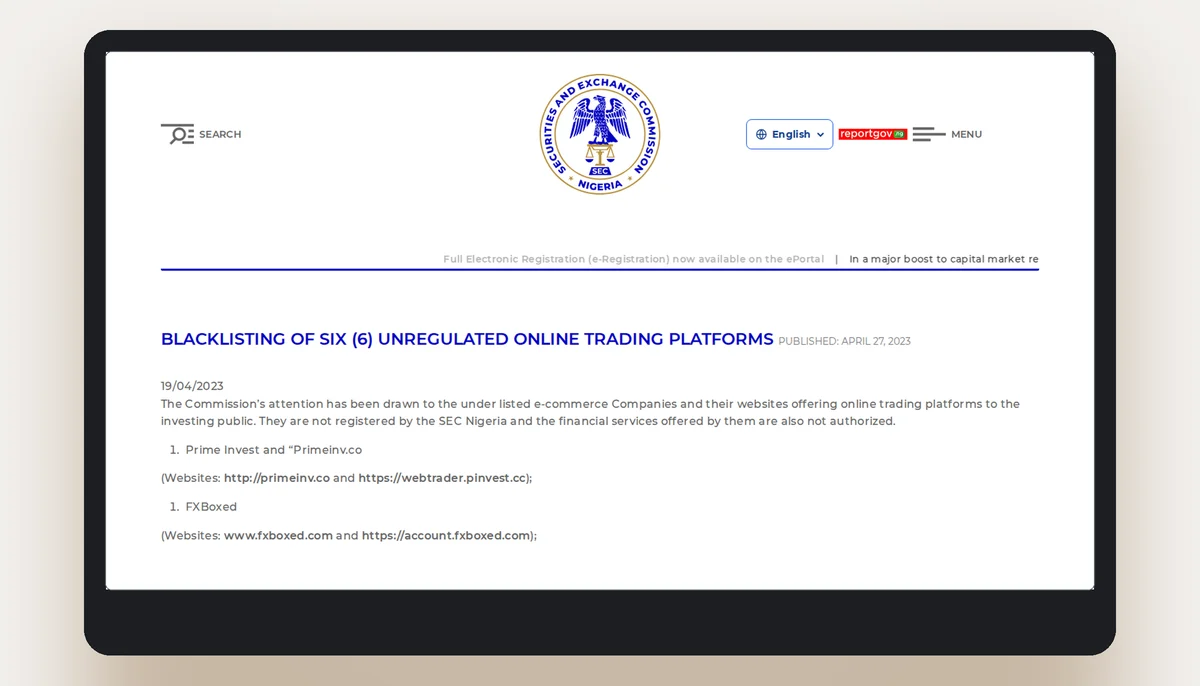
The Securities and Exchange Commission of Nigeria publishes a register of registered operators and public notices about unregistered operators. Some of those notices name forex and crypto platforms. This page explains what a reader can and cannot conclude about a forex platform from those publications, and what to ask the platform.
SEC notices about forex platforms
The Commission has issued public notices about operators it says are not registered. Some of those notices name forex platforms. A notice is a public statement by the Commission. It may say that the named operator is not registered with the Commission and is offering services to the public.
A notice is not a court judgment. It is the Commission's published position. It does not prove that the operator is unlawful. It is evidence that the Commission considers the operator unregistered. The notices table on this site shows those notices as the Commission published them.
Being offshore does not make a platform lawful or unlawful
Many forex platforms are based outside Nigeria. They may be registered in another country. Being offshore does not by itself make a platform lawful or unlawful in Nigeria. A platform may be lawful in its home country but not registered with the SEC Nigeria. Or it may be registered with the SEC Nigeria but not with its home regulator.
The question is whether the platform is allowed to offer its services to the public in Nigeria. That depends on Nigerian law, not on the platform's home country. The SEC Nigeria's register and notices are one source of information. The Central Bank of Nigeria's rules govern moving foreign currency.
The Central Bank's role
The Central Bank of Nigeria regulates foreign exchange. Its rules govern how naira can be exchanged for foreign currency and how money can be moved across borders. A forex platform that lets you trade currency pairs may be subject to the Central Bank's rules, even if it is also subject to the SEC's rules.
This site does not summarise the Central Bank's rules in detail. The reader should check the Central Bank's own publications. The key point is that the SEC register is not the only regulator relevant to forex. The Central Bank's rules matter too.
What to ask a forex platform
Before you open an account with a forex platform, ask for three things: the legal entity name, the home regulator, and the licence number. The legal entity is the company you will be dealing with. The home regulator is the authority that supervises that entity in its home country. The licence number is the identifier in the home regulator's register.
Then check those details. Search the SEC Nigeria register for the legal entity. Search the home regulator's register for the licence number. The home regulator's register should show the entity and its status. If the platform cannot or will not give you these details, that is a warning sign.
What the SEC register does not tell you about forex
The SEC register tells you who the Commission has registered to act in the capital market. It does not tell you whether a forex platform is safe, whether its prices are fair, or whether you will make money. It does not tell you whether the platform is allowed to offer forex to the public in Nigeria.
Forex trading is risky. The value of currencies moves constantly. Leverage can amplify losses. The SEC register is not a rating of forex platforms. It is a list of registered capital-market operators. A forex platform may not be on the register because the Commission has not registered it, or because it does not fall under the Commission's authority.
What to do before trading forex
Check the SEC Nigeria register and the public notices. Then check the home regulator's register. Read the platform's terms and risk warnings. Understand the product you are trading. Forex contracts are often leveraged, which means you can lose more than your initial deposit.
Do not rely on a single source. The SEC register, the home regulator's register, and the platform's own documents are all pieces of the puzzle. The reader decides. This site does not tell you whether to trade or which platform to use. It shows the records and explains what they mean.
A forex platform can hold a CBN licence without appearing on the SEC register
Forex dealing in Nigeria is supervised by the Central Bank, not the Securities and Exchange Commission. A platform may hold a valid CBN licence for foreign exchange services and still have no entry on the SEC's register of capital market operators. The SEC register only covers entities that fall under its own regulatory scope, such as investment firms and securities dealers. When a reader asks whether a forex platform is licensed by the SEC, the honest first step is to check which regulator the platform claims to be under.
This distinction matters because the two registers serve different purposes. The CBN publishes its own list of licensed financial institutions, and a forex platform may appear there while being absent from the SEC register. A search on the SEC website that returns no result does not by itself mean the platform is operating without any licence. It means the platform is not registered with the SEC as a capital market operator, which may be entirely consistent with its business model.
Before concluding anything, compare the platform's stated regulatory status with the correct register. If the platform says it is regulated by the Central Bank, check the CBN's published list. If it says it is registered with the SEC, check the SEC register. A mismatch between the claim and the public record is a question to put to the platform. The absence of an SEC registration is only meaningful when the platform actually claims to hold one.
A notice about an unregistered platform tells you nothing about its current conduct
The SEC publishes notices warning the public about entities that are not registered to offer capital market services. These notices are a snapshot of the Commission's view at the time they were issued. They do not say that a platform has taken money and failed to return it, or that its current operations are unlawful. They say the entity was not registered with the SEC at the date of the notice and was offering services that fall within the Commission's regulatory perimeter.
A reader who finds such a notice should note the date and read the wording carefully. The notice may list a name that is similar to a platform the reader is asking about. The notice does not assess the platform's solvency, its treatment of customers, or its compliance with other regulators. It is a regulatory flag, not a verdict on the platform's behaviour. The Commission's own disclaimer in these notices typically states that the public should exercise caution, but it does not assert that the entity is defrauding anyone.
For a current decision, the notice is only one input. Check whether the platform has since obtained registration, whether the notice refers to the same company or a similar name, and whether the platform's services have changed. The SEC register should be searched for the exact legal name of the platform. If the notice predates a registration, the later register entry supersedes the earlier warning. The reader should not rely on an old notice to conclude that a platform is unsafe today.
The SEC register does not record customer complaints or enforcement outcomes
A name on the SEC register means the entity has met the Commission's requirements for registration as a capital market operator. It does not mean the entity has no pending complaints from customers, no disciplinary history, or no enforcement action against it. The register is a licensing record, not a conduct record. The SEC publishes enforcement actions separately, and a reader who wants to know whether a platform has been sanctioned must look at those publications, not at the register itself.
This gap often leads readers to overstate what a register entry proves. A registered platform can later be suspended, fined, or have its registration withdrawn, and the register may not show that history on the same page. The register typically shows the current status, which may be 'active' or 'suspended', but it does not list the reasons for a status change or the details of any past enforcement. A registered entity is not automatically a safe entity.
To build a fuller picture, check the SEC's enforcement page and any public notices about administrative proceedings. The register answers one question: is this entity registered with the SEC? It does not answer the question of whether the entity treats customers fairly, whether it has been sanctioned, or whether its registration is under review. Those are separate questions with separate public records, and each requires its own search.
A platform's claim of SEC registration should be checked against the register's category and status
When a platform says it is registered with the SEC, the next step is to find its entry on the register and read the category and status columns. The category tells you what the entity is permitted to do, such as broker/dealer, fund manager, or investment adviser. The status tells you whether the registration is currently active, suspended, or inactive. A platform may be registered in one category while offering services that fall into another category, which would be outside its registration.
Readers often assume that any registration covers all financial services. That is not how the register works. A platform registered as a fund manager is not registered to act as a broker/dealer. A platform registered as a broker/dealer is not registered to act as a digital asset service provider unless the register shows that additional category. The category is the boundary of what the regulator has approved, and the status shows whether that approval is currently valid.
If the platform's website advertises services that do not match the category on the register, that is a discrepancy to raise with the platform. The register does not list every activity the platform may lawfully undertake; it lists what the SEC has registered it for. A mismatch between the platform's own description of its services and the register's category is a red flag that the platform may be operating beyond its registration.
The SEC's digital asset rules do not convert every forex platform into a capital market operator
The SEC has issued guidance on digital assets, which includes rules for virtual asset service providers. Under that guidance, a platform that facilitates the trading of digital assets may be required to register with the SEC. But a forex platform that deals only in fiat currency pairs is not automatically a digital asset service provider. The two are distinct under Nigerian law, and a forex platform's obligation to register with the SEC depends on the specific assets it offers.
A platform that offers both forex and cryptocurrency trading may need to meet the SEC's requirements for the digital asset side of its business, while the forex side remains under the Central Bank's supervision. The SEC register would then show the platform as a digital asset operator, not as a forex broker. The register does not have a category labelled 'forex broker' because that activity is not within the SEC's traditional perimeter.
When checking a platform that offers both services, look for separate entries or a combined entry that lists the digital asset category. The absence of an SEC registration for the forex part is expected. The presence of an SEC registration for the digital asset part does not mean the forex part is regulated by the SEC. The reader must ask which regulator covers the specific service they intend to use, and then check that regulator's register.
Key facts
Read next
Licence questions people send us
Is forex trading legal in Nigeria?
This site does not say whether forex trading is legal or illegal in general. The legal position depends on the specific activity and the regulators involved. The SEC Nigeria regulates capital-market operators. The Central Bank regulates foreign exchange. A platform may be lawful or unlawful depending on its registration and the services it offers.
What if a forex platform is not on the SEC register?
A name not on the SEC register means the Commission has not registered that entity. It does not mean the platform is unlawful. The platform may be regulated by another body, or it may be based abroad. Check the public notices table and ask the platform for its home regulator and licence number.
What is a home regulator?
A home regulator is the authority that supervises the platform in the country where it is based. For example, a platform based in the United Kingdom may be regulated by the FCA. The home regulator's register shows whether the entity is authorised and what activities it is allowed to do.
How do I check a home regulator's register?
Ask the platform for its legal entity name and licence number. Then go to the home regulator's website and search its register. The register should show the entity's name, status, and the activities it is authorised to do. If the entity is not there, ask the platform to explain.
What does a SEC notice about a forex platform mean?
A SEC notice is a public statement by the Commission. It may say that the named operator is not registered with the Commission and is offering services to the public. The notice is not a court judgment. It is the Commission's position. Read the notice carefully to see what it says.
Open an account with FxPro
FxPro is an international broker offering CFDs on currencies, metals, indices, shares and crypto. CFDs are leveraged and carry a high risk of losing the money deposited. This site is not the broker and takes no money from you.